

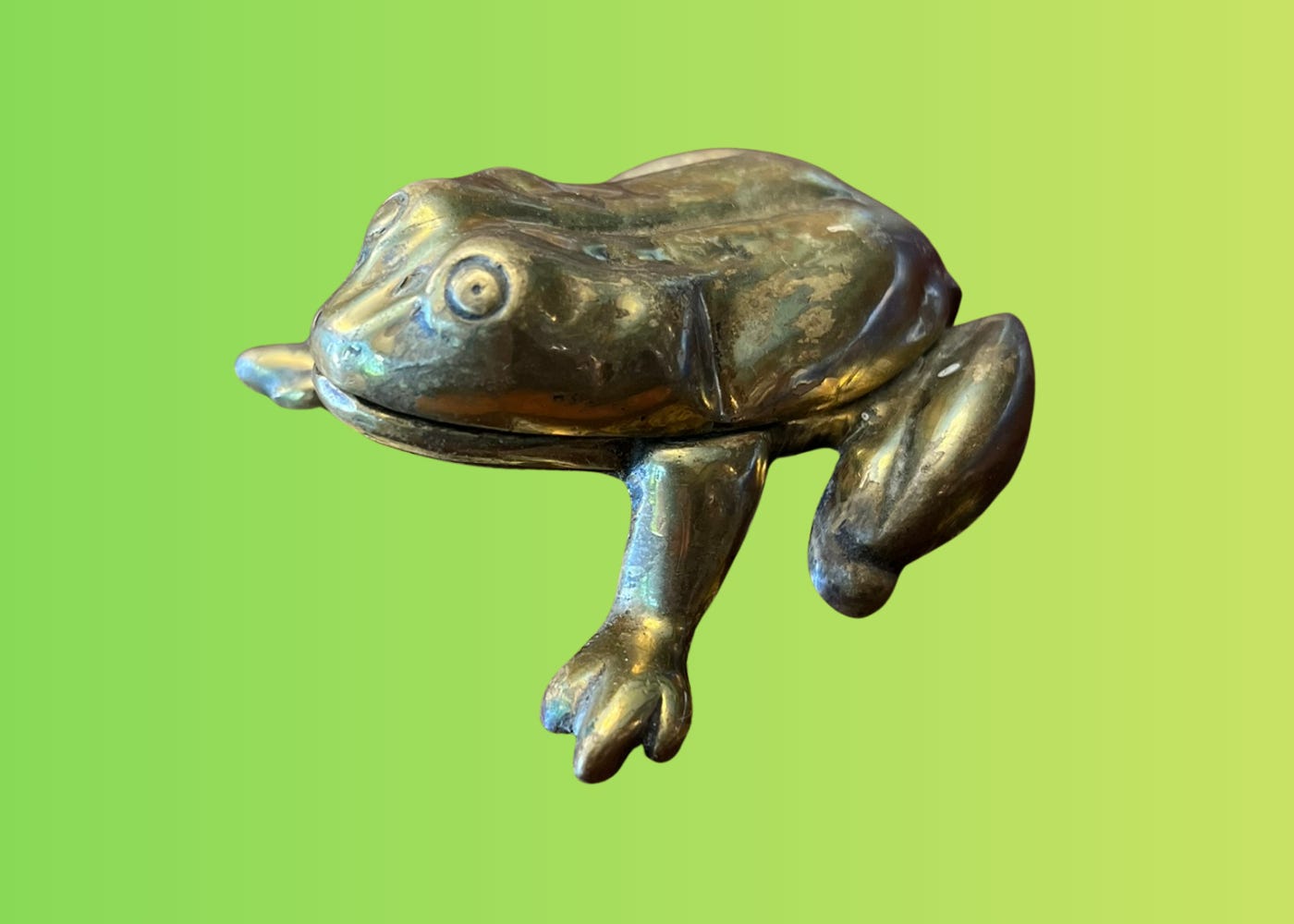
At the start of April, I attended a writers retreat at Insole Court in Cardiff, led by my writing mentor Briony. We were asked to bring in three objects that mean something to us. Before we wrote about our personal effects, we were asked to pick a random object from a table in the corner of the room. I chose a small bronze frog. I asked Briony what the frog was for. She assumed, and her family too assumed, it was an ash tray. I wrote this piece about that frog.
The Frog
Mr Yuto Kumagai was a collector of things. To look at him. A slightly built elder, with a mop of dyed black hair, accusatory eyes, a pencil moustache, severe lips and an aura of superiority, you would think Mr Kumagai too serious for the silly or the obscure. He was after all, an architect. A serious profession. All straight lines and modernity. He had designed libraries and civic centres, music halls and celebrity homes. Angular, concrete, monolithic, imperious and clean.
The exterior of Mr Kumagai’s house was in keeping with his own. A long, sleek rectangle, austere on the outside. Wooden panelled and soft on the inside. The whole house jutting out onto a beach. Mr Kumagai’s home was designed to be a communion with, and part of the coastline on one single level.
Mr Kumagai’s living room was flooded with light, and dotted with oddities, collectables. Wooden masks, pieces of pottery, oddly shaped glass sculptures. Objects from every continent.
By his reading chair, on a small glass table, sat a bronze frog, with manic eyes staring in different directions. Its mouth a lid that opened into an ash tray.
Mr Kumagai would arrive at his reading chair, the living room drenched in the long beams of coastal light. He would sit down with his newspaper and read abut the world, current affairs, politics, business and a smattering of sport. Without fail, he would take out a packet of Camel cigarettes. He would light that small stick of wrapped tobacco with a silver lighter bought at a flea market in Little Rock, Arkansas. The lighter emblazoned with an eagle. He would puff on that camel, and flicked open the bronze frog, newspaper in his lap. And he would stare at the frog, its scooped-out innards on show, gathering ash. And he would think about where he had bought that little frog from.
It was a marble grey day in Camden Market, London. The frog sat there facing away from him. The seller saw Mr Kumagai staring at the frog and turned it to face him. Without a word Mr Kumagai picked up the frog, and he held it flat in his palm.
“He’s £10,” said the seller.
Mr Kumagai gave her £20 and slipped the frog into his deep duffle jacket pocket, and he went on his way.
Smoke filling the space around him, Mr Kumagai rested his cigarette in the frog and opened the paper.
The United State was threatening war. Europe was in a frenzy. Russia was asserting its dominance. Iran was firing back. Israel and China, and all the chess pieces were moving. Japan was pondering whether to vote for a conservative female Prime Minister, over someone more on the liberal side of Japanese politics.
Mr Kumagai thought of his father who had fought in the war. Who had hated everything of conflict and knew the shame of such things. And he read that conservatives in his country were talking up an expanded military, a bigger role in international affairs. Mr Kumagai grew tired of the paper. He took his cigarette, the pack of Camels and the frog, and moved across the living room to a large sliding door, opening it to the crashing waves.
Mr Kumagai sat out on the balcony and stayed there until the sunset. His anxieties washed away.